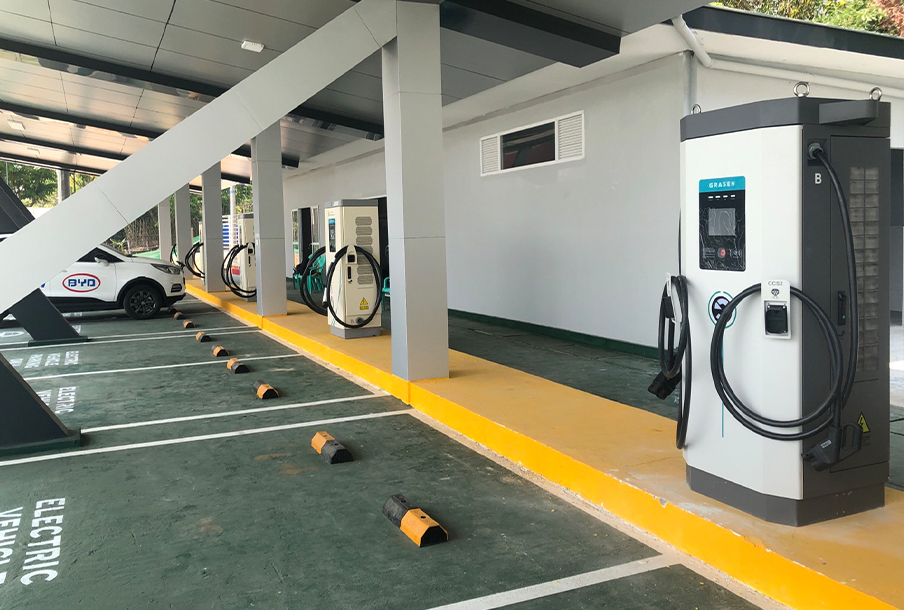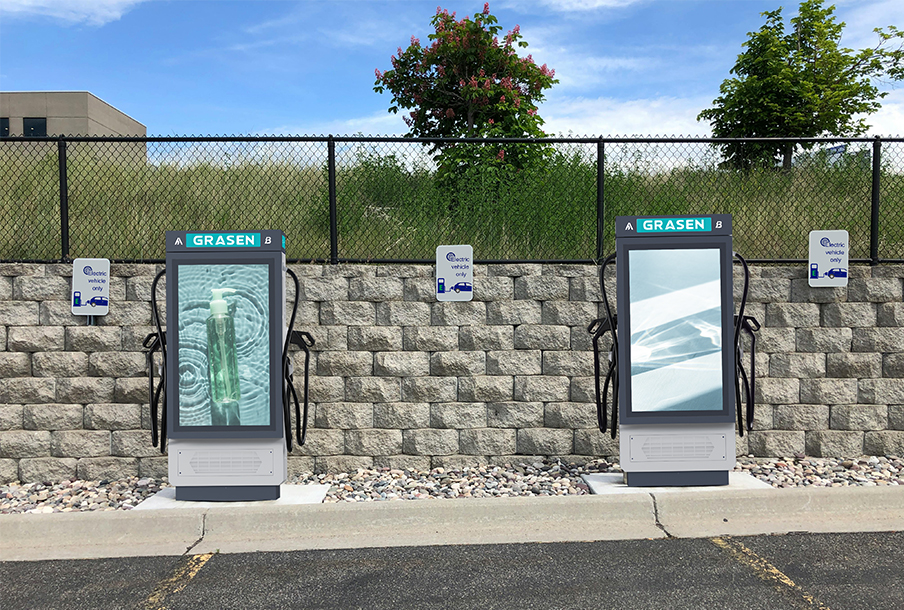



At a glance, two EV chargers can seem almost identical. You plug in the cable, the car starts charging, and that appears to be the whole story.
It isn’t.
Behind the enclosure, one charger may simply supply AC power and leave the conversion work to the vehicle. Another may contain its own high-power conversion system and send DC directly toward the battery. Connector standards vary too, as do power levels and the software used to control a charging session.
So, are all electric vehicle chargers the same? Only in the sense that they are all there to recharge an EV. How they do that can be quite different.
How Do EV Chargers Actually Work?
The outside design tells you very little about what is happening electrically.
In simple terms, the charging path looks something like this:
Grid power → charging equipment → communication with the vehicle → battery
Connecting the cable is only the beginning. Before useful charging power starts flowing, the vehicle and charger communicate and establish the conditions for the session.
There is another point that helps make sense of the different charger designs: the battery stores energy in DC form.
So whenever AC power is involved, it must be turned into DC somewhere between the grid and the battery. Where that conversion happens is one of the main reasons AC and DC chargers are built differently.
AC vs DC EV Charging: Where Does the Conversion Happen?
The battery ultimately receives DC power in either case. What changes is which piece of equipment does the conversion.
AC Charging
For AC charging, the route is roughly:
Grid AC → EVSE → onboard charger → DC → battery
The charging point supplies AC electricity, and the vehicle takes care of the next step. Inside the car, its onboard charger (OBC) converts the incoming AC into DC.
That onboard equipment has its own power limit.
Suppose a car is designed to accept a maximum of 11kW through AC charging. Connecting it to a 22kW AC unit still leaves the vehicle charging at roughly its own 11kW limit. The extra capacity on the charger side does not change what the OBC can process.
For a car parked overnight or left at an office for most of the working day, that is usually fine. The vehicle has enough time to charge without needing very high power.
DC Fast Charging
DC charging handles the conversion earlier in the process:
Grid AC → DC fast charger → DC → vehicle battery
Instead of asking the car's onboard charger to convert the power, the DC charger does that work before the electricity reaches the vehicle.
A large commercial charger also has far more room for power modules, cooling and conversion equipment than a passenger car. That is what makes much higher charging output practical.
This is why DC charging is commonly found at places where time matters more—highway charging stops, fleet depots and busy public charging stations.
In both cases, the battery ends up receiving DC power. The difference is simply which side of the charging cable performs most of the conversion work.
Why Do EV Chargers Have Different Power Levels?
EV charger specifications span a surprisingly wide range. You might see 7kW or 22kW on an AC unit, while commercial DC equipment can reach 120kW, 240kW, 480kW or more.
There is a practical reason for that range: vehicles do not spend the same amount of time at every location.
An office employee might leave a car parked for six or eight hours. A hotel guest may have all night. A taxi driver between jobs has far less time, and someone stopping on a highway usually wants enough energy to continue the trip as quickly as possible.
Those different parking patterns call for different charging approaches.
Even so, the number written on the charger is only its available capacity. Actual EV charging speed also depends heavily on the car.
For example, a 240kW charger may be connected to an EV that requests only 90kW at that point in the session. In that situation, the charger follows the vehicle's request instead of pushing the full 240kW.
Several factors can affect the power you actually see:
· vehicle maximum charging capability;
· battery voltage;
· state of charge;
· battery temperature;
· charging curve;
· charger output limit.
Two EVs can therefore plug into the same charger and show quite different power readings, even a few minutes apart.
Does More Charger Power Always Mean Faster Charging?
No—not automatically.
Think of the charger rating as available headroom.
If a 240kW charger is connected to a car asking for 80kW, there is plenty of unused charger capacity, but the session will still remain near the level requested by the vehicle.
The requested power can also move during the session.
Battery condition changes as charging progresses, and the vehicle's battery management system adjusts the acceptable power accordingly. Many EVs charge strongly at a lower state of charge and then begin to taper as the battery fills.
That is why a charger's maximum rating should not be read as a guaranteed charging speed for every car.
Actual charging performance comes from the combination of:
charger capability + vehicle capability + battery condition
Higher-power equipment is most useful when the vehicles can take advantage of it and when reducing time at the charger has real value for the site.
Are All EV Charger Connectors the Same?
No.
EV charging still uses several connector standards, including:
· Type 2;
· CCS1;
· CCS2;
· CHAdeMO;
· GB/T;
· NACS.
The connector you find on a charger usually reflects the vehicles it is expected to serve and the market where the equipment is installed. AC and DC charging may also use different interfaces.
That means EV charging is not universally plug-and-play across every vehicle.
A charger can only connect properly when its interface matches what the car supports.
So if the question is “Do all EV chargers fit all cars?”, again, the answer is no.
For one driver, this may be little more than checking the plug type before charging. A commercial operator has to think further ahead. One site may need to serve different vehicle brands, mixed fleets or vehicles built to different regional standards.
Home vs Commercial EV Chargers: Where the Differences Start to Matter
Both types put energy into an EV, but the job around that charging session can be very different.
A typical home charger may focus on:
· AC charging;
· lower charging power;
· overnight charging;
· simple user access.
A commercial EV charger may need additional functions such as:
· DC fast charging;
· higher power output;
· multiple connectors;
· RFID or app access;
· payment functions;
· OCPP;
· CSMS integration;
· load management;
· remote monitoring;
· charging records.
At home, the charger may be used by the same one or two vehicles every day.
A commercial charger could see dozens of different drivers. The operator may also need to collect payments, review sessions, check equipment remotely or manage chargers spread across several sites.
The battery does not care whether it is charging at someone's house or in a public car park. The person operating the charging system certainly does.
Why Do Some EV Chargers Have More Smart Features?
A home charger often has a fairly simple routine: connect the vehicle, confirm that charging can start, and let the car sit.
A public charger has a much longer checklist.
Who is the driver?
What tariff should be used?
How will payment be handled?
How much energy did the session consume?
Is the charger online?
Can a fault be checked without sending someone to the site?
That is where software becomes important.
Commercial chargers may use OCPP and a CSMS to support:
· user authentication;
· charging tariffs;
· payment;
· charging history;
· remote monitoring;
· remote control;
· load management;
· fault information.
The electrical job—moving energy toward the battery—has not changed.
What changes is everything the operator needs around that job.
Consider two 120kW chargers. Their power specification may look almost identical, yet one could operate independently with basic controls while the other connects to payment services, remote diagnostics and a network of chargers managed from one platform.
The difference becomes much more obvious after the equipment is installed and put into daily use.
So, Are All Electric Vehicle Chargers the Same?
If we only look at the final goal, they have something in common: they all recharge an electric vehicle.
Once you look at the equipment and the way it is used, however, the differences are substantial.
One charger may depend on the car's onboard charger to convert AC power. Another may handle high-power DC conversion before the electricity reaches the vehicle. Connector standards vary between markets, charging power can differ dramatically, and commercial installations often require software and operating functions that would have little purpose in a home garage.

So rather than asking whether every EV charger is the same, it is usually more useful to ask:
“Does this charger make sense for this vehicle and this site?”
For a home installation, the answer may come down mainly to connector compatibility and available charging power.
For a commercial site, there is usually more to check: connector standards, power requirements, payment, OCPP, backend integration, load management and how the equipment will be operated over time.
Need Help Choosing the Right EV Charger?
For commercial EV charging projects, Grasen can review the main technical and site requirements before the charger configuration is finalized.
Send us your target market, vehicle type, required charging power, connector standard, charger quantity and software requirements, and our team can review the project and suggest a suitable charging configuration.
Email: [email protected]
Website: www.grasen.com
WhatsApp: +86 199 3989 0561