


Choosing EV charging equipment for a business usually starts with more than a power rating.
An office car park, a hotel, a shopping center, a fleet depot and a public charging site may all install chargers, but the way those chargers are used can be completely different. Some vehicles stay all day, some only stop briefly, and some sites see several vehicles arrive at almost the same time.
That is why choosing a business electric car charger should start with how the site actually operates.
For some companies, a few AC chargers may be enough. Others may need high-power DC charging, payment functions, remote management and a complete charging network.
This guide explains how to compare business electric car chargers and choose a commercial charging solution that matches the vehicles, parking time and operating model of the site.
Start with the Business, Not the Charger
Before comparing charger models, ask one basic question:
Why is the business installing EV charging?
A workplace may want to provide charging for employees who park for most of the day. A hotel may need overnight charging for guests. Shopping centers may want to add charging as a customer service while also increasing time spent on site.
Fleet operators look at the problem differently. If vehicles need to leave again for another shift or route, waiting several hours to charge may not be practical. In that situation, charging speed and charger availability become much more important.
A public charging site usually has even more to manage. Besides the charger itself, the operator may need payment, user access, backend software and remote monitoring.
So the same EV charger for business can make sense in one location and be a poor fit in another.
A useful place to start is the daily vehicle pattern: how many cars arrive together, how long they normally remain parked, and when they need to be back on the road.
AC or DC? Let Parking Time Decide
A common early decision is whether the site needs AC charging, DC fast charging, or a mix of the two.
AC charging often works well where cars remain parked for several hours. Offices, hotels and long-stay parking areas fall into this category because the vehicle has enough time to recover energy gradually.
DC charging becomes more relevant when that parking window gets shorter.
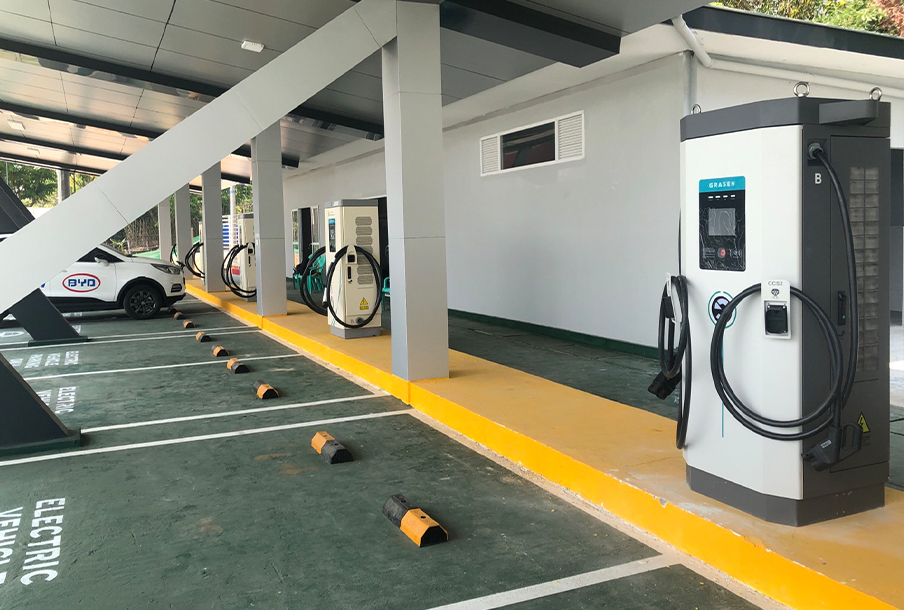
At a fleet depot, vehicles may need to be ready for the next shift. Taxi and ride-hailing drivers often cannot spend several hours waiting for a charge. At highway sites, the expectation is different again: drivers usually want to continue their journey as soon as possible.
That leads to a simple rule:
Long parking time usually favors AC. Short turnaround time usually favors DC.

The right commercial EV charger should follow the way people already use the parking space. Adding more power than the site can realistically use does not automatically improve the charging experience.
How Much Charging Power Does a Business Really Need?
Once AC or DC has been decided, the next question is power.
The highest kW number is not always the most useful choice.
A practical power decision usually comes back to four things: the vehicles on site, how long they remain parked, how much charging takes place each day and how much electrical capacity is available.
Vehicle capability sets one limit. Even if the charger can deliver more power, the vehicle will only take what its battery and charging system can accept.
Parking time changes the calculation as well. A car that remains on site for six hours has very different charging needs from one that needs to leave again in twenty minutes.
Daily demand is also important. Ten vehicles charging occasionally create a different load from fifty fleet vehicles returning at the same time.
Finally, the site itself has limits. A high-power commercial EV charging station may require additional electrical infrastructure if the existing supply cannot support the planned load.
This is why a workplace may be perfectly well served by AC charging, while a fleet project may justify 120kW, 240kW or higher DC power.
For a DC fast charger for business, power should be chosen around actual operating demand, not simply the largest number in the product catalogue.
One Charger Is Easy. A Charging Network Is Different.
One or two chargers at a single location are usually straightforward to manage.
The situation starts to look different when the same business operates 10, 30 or 50 units.
At that scale, commercial EV chargers are no longer isolated pieces of equipment. They need to work together as part of a charging network.
Operators may want to see which units are online, who is charging, how much energy each session has used and whether an error can be checked before someone is sent to the site.
This is where OCPP, CSMS and remote management become important.
OCPP can allow compatible chargers to communicate with charging management platforms. A CSMS can then support functions such as charger monitoring, user management, charging records, tariffs and remote operation.
Load management may also become necessary when several chargers share the same electrical supply.
For larger EV charging for businesses projects, software should therefore be considered at the same time as the charger hardware.
Planning the hardware, communication method and backend together from the start usually makes a growing charging network much easier to operate later.
What Should You Look for in a Commercial EV Charger?
The features that matter most depend on what the site expects the charger to do.
A free workplace charger may only need simple user access. A public charging business may require several payment methods and a more advanced backend.
For paid charging, buyers may need to consider mobile apps, RFID cards, POS terminals or third-party payment integration.
Connector standards are another basic requirement. The correct choice depends on the target market and vehicles using the site, whether that means CCS1, CCS2, CHAdeMO, GB/T, NACS or another configuration.
Remote maintenance also deserves attention. When several commercial EV chargers are installed across different locations, features such as remote updates, log access and fault diagnosis can reduce unnecessary site visits.
The user interface matters as well. Screen size, status indicators, physical controls and cable management can all affect daily operation.
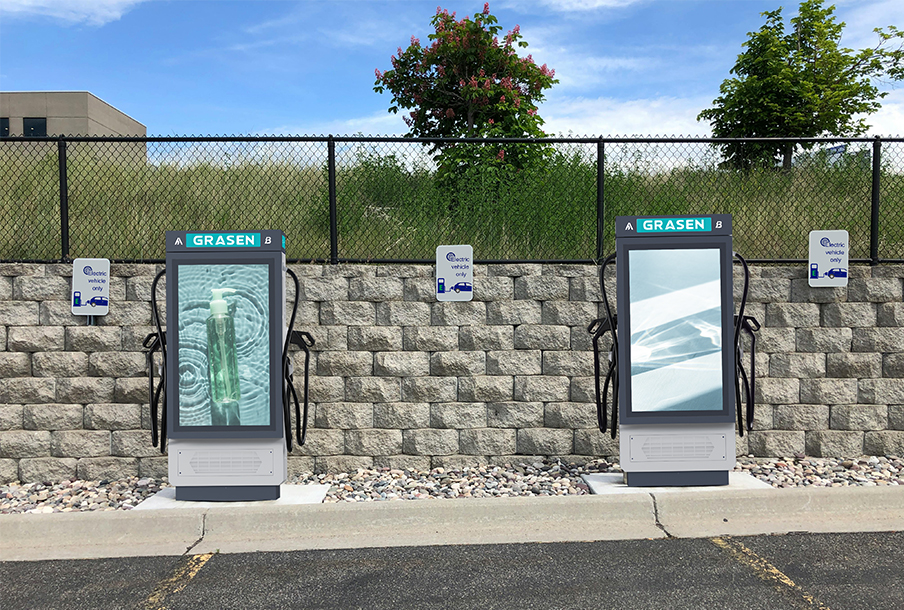
Some commercial properties may also want charging equipment to support other business functions. For example, chargers with large advertising displays can combine EV charging with digital media and promotions.
In that case, the business electric car charger is doing more than supplying energy. It becomes part of the customer experience and the site's wider commercial strategy.
Match the Charger to the Business Type
There is no single best charger for every business.
An office with employees parking all day may benefit more from multiple lower-power chargers than one expensive high-power unit.
Hotels often have similar conditions because vehicles remain parked overnight.
Retail sites are less predictable. Some may be satisfied with AC chargers, while higher-traffic shopping centers may benefit from DC charging to serve more vehicles throughout the day.
Fleet projects usually place greater value on charging speed, reliability and centralized management. A fleet may also need several DC fast chargers for businesses rather than individual standalone units.
Public and highway charging sites push the requirements further. High-power DC charging, payment, OCPP, remote monitoring and high equipment utilization become more important.
The right EV charger for workplace use is therefore very different from an EV charger for fleet use case.
What Should You Tell a Supplier Before Asking for a Quote?
A useful charger quotation needs more than a requested power rating.
Before contacting a supplier, prepare basic project information such as the target country, business type, vehicle type, number of vehicles, expected parking time, required charging speed, connector standard and estimated charger quantity.
It is also worth stating whether the project needs payment functions, OCPP, a CSMS, remote management or load balancing.
Site power conditions matter too. If the available electrical capacity is already known, share it early.
This information helps the supplier recommend a suitable configuration instead of simply quoting a standard model.
For international projects, certification and local technical requirements should also be confirmed for the specific product being considered.
Choosing the Right Business Electric Car Charger
A business electric car charger works best when it matches the way vehicles already use the site.
For one company, that may mean several AC charging points spread across an employee car park. For another, it could mean a high-power DC system with payment, OCPP and remote management.
A good commercial charging project is therefore less about choosing the most powerful charger and more about making the charger, software and site infrastructure work together.
Grasen supplies AC and DC charging solutions for workplace, hotel, commercial parking, fleet and public charging applications.
If you are comparing EV chargers for businesses, send us your target market, vehicle type, charging power, connector requirement, expected quantity and software needs. Our team can review the project and recommend a suitable configuration.
Email: [email protected]
Website: www.grasen.com
WhatsApp: +86 199 3989 0561