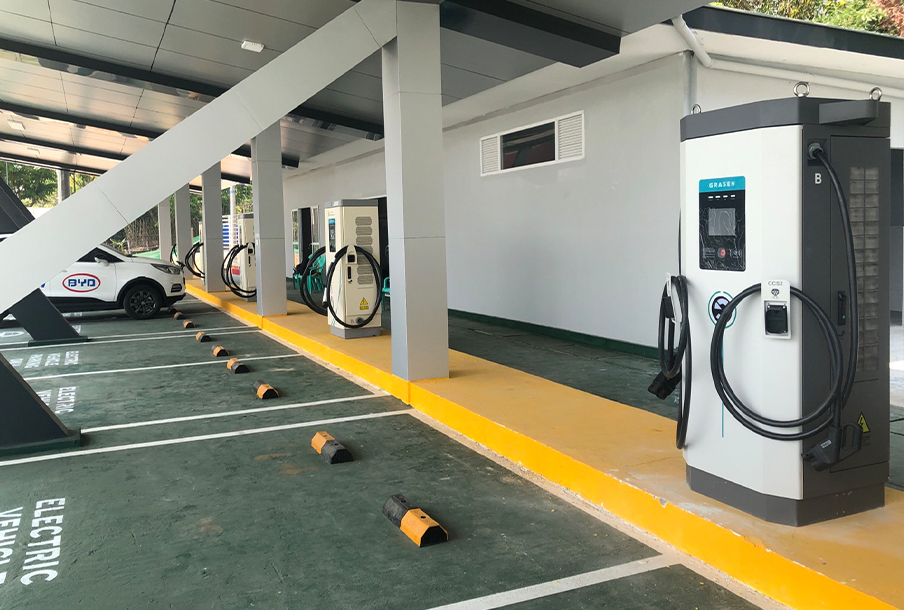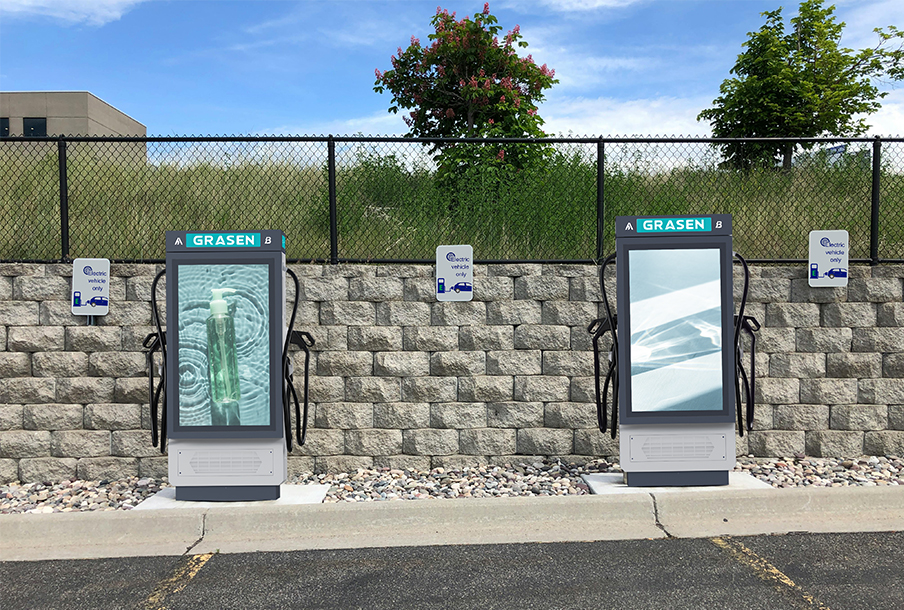



A commercial EV charging project can be as simple as several AC chargers in an office car park or as large as a high-power public charging hub.
That makes it difficult to put one price on a “commercial charging station.” For early budgeting, it is more useful to separate charger hardware from installation and site infrastructure. Equipment prices can be estimated within a broad range, while labor, electrical work and construction need to be calculated for the actual site.
How Much Does Commercial EV Charging Equipment Cost?
For early-stage budgeting, the following ranges can be used as a practical reference for equipment supplied by Chinese export-oriented EV charger manufacturers.

These figures refer to charger hardware only. Freight, import duties, local taxes, installation labor, transformers, switchgear, trenching, civil work and grid upgrades are not included.
Power rating is only one part of the price. Two 240 kW chargers, for example, may have different connector combinations, output currents, cable specifications, communication hardware or certification packages. Order quantity and optional features can also change the final equipment cost.
Workplace EV Charging
Workplace vehicles are often parked for several hours, which makes 11–22 kW AC charging suitable for many office and industrial sites.
With commercial AC charger hardware typically around $210–$360, businesses can often provide more charging points without immediately moving into much more expensive DC fast charging.
The installation cost still needs to be calculated locally. A charger installed close to an existing electrical distribution point may require relatively little additional work, while a large car park with longer cable routes or limited electrical capacity can be a very different project.
Hotel and Destination Charging
Hotels usually serve both overnight guests and shorter-stay visitors.
For guests leaving their cars parked for several hours, AC charging is often sufficient. Faster DC charging can then be added in selected spaces for drivers who need a quicker top-up.
This means a hotel does not necessarily need high-power DC equipment at every parking space. A combination of AC chargers for longer stays and a limited number of DC chargers for faster charging can make better use of the available budget.
Pedestal installation, underground cabling and additional electrical work should all be priced according to the property itself.
Shopping Centers and Commercial Car Parks
Commercial car parks have a wider range of parking times, so a mixed AC and DC layout often makes sense.
AC chargers can serve customers staying for several hours. For faster-turnover spaces, a site may consider 60–160 kW DC charging, while busier locations may move into the 160–240 kW range.
For early hardware planning, 160–240 kW DC chargers can be budgeted at roughly $13,000–$19,000 per unit, depending on configuration.
The aim is not to place the highest-power charger in every space. A better approach is to reserve higher-cost fast charging for areas where the expected traffic can actually make use of it.
Fleet Depot Charging
Fleet projects depend heavily on vehicle schedules.
Vehicles parked overnight may be able to charge at lower power. Fleets with short turnaround times may require 120 kW, 160 kW, 180 kW, 240 kW or higher-power DC equipment.
The expensive part of a fleet project is not always the charger itself. Supplying maximum power to many vehicles at the same time can require larger transformers, switchgear and grid capacity.
Dynamic load management can distribute available power between vehicles and reduce unnecessary peak demand.
For this reason, larger fleet projects are usually better evaluated as a complete charging system rather than by multiplying one charger price by the number of vehicles.
Public Charging Stations
Public charging projects can range from a single 60 kW charger in an urban car park to a highway charging hub using 240 kW, 400 kW or 480 kW equipment.
At these sites, higher power should be justified by vehicle turnover.
A lower-traffic location may work well with a smaller DC charger. A busy highway station may benefit from higher charging power because shorter charging sessions allow each charging point to serve more vehicles during the day.
For larger charging hubs, distributed charging systems can also be considered. Instead of assigning maximum power to every parking space, a central power system can dynamically distribute available capacity across several charging terminals.
Because the number of power modules, dispensers, connectors and charging positions changes from one project to another, distributed systems should normally be treated as project-specific solutions, even when a broad equipment range is used for early budgeting.
For larger or higher-power charging projects, equipment selection should be based on the site’s traffic, charging demand and available electrical capacity rather than power rating alone.
Price Note
The hardware ranges shown in this article are indicative market-average estimates based on typical overseas selling levels among Chinese EV charger export manufacturers. They are intended for preliminary budgeting only and should not be treated as fixed Grasen quotations.
These figures are broad market estimates rather than a statistical industry price index. Actual equipment prices may vary with power rating, connector configuration, output current, certification, order quantity, optional functions, customization, shipping terms and destination market.
Installation and infrastructure costs must be evaluated separately for each project. Electrician rates, labor hours, transformers, switchgear, cable length, trenching, civil work, permit requirements, grid connection conditions and local regulations vary significantly between countries and individual sites.
A site-specific quotation is therefore required before the final commercial EV charging station budget can be confirmed.
Get a Project-Specific EV Charging Cost Estimate
If you are planning a workplace, hotel, commercial car park, fleet depot or public charging station, a few basic project details are usually enough to begin estimating the equipment configuration and preliminary budget.
Useful information includes:
· Country or target market
· Site type
· Number of charging points
· Required charging power
· Available grid capacity or input voltage
· Connector standard
· Payment requirements
· OCPP / CSMS requirements
· Site drawing or installation layout, if available
You do not need to have every technical detail ready before getting in touch. Information about the site, expected charging demand and number of vehicles is usually enough to start narrowing down the solution.
For larger projects, early planning can also help avoid unnecessary spending on oversized chargers, transformers or electrical infrastructure.
Get a Project Cost Estimate
Email: [email protected]
Website: www.grasen.com
Not sure which charging configuration fits your project? Send us your basic requirements, and the Grasen team can help evaluate a more suitable solution and preliminary budget.