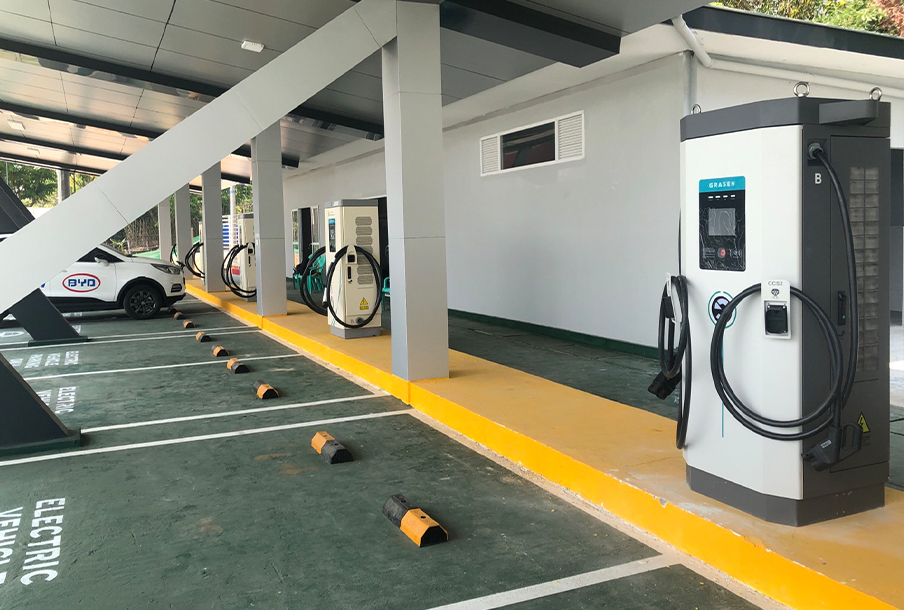



DC fast charger prices can vary significantly, even when two chargers have the same rated power.
A 120 kW charger with a basic configuration may cost very differently from another 120 kW charger equipped with higher-current cables, multiple connectors, payment hardware, market-specific certification, backend integration, or additional service support.
For buyers, it is more useful to look at approximate equipment costs by power level and then compare what is actually included in each quotation.
The figures below are intended as preliminary hardware references rather than fixed selling prices.
30–60kW DC Fast Charger Cost
The 30–60 kW range is one of the more accessible entry points into commercial DC fast charging.
For early budgeting, 30–60 kW DC fast charger hardware can generally be estimated at around $5,500–$9,500.
This power range is often considered where faster charging is needed but the site does not require the electrical capacity of larger 120 kW, 240 kW, or ultra-fast charging systems.
Compared with higher-power equipment, compact DC chargers may also place less demand on the existing electrical infrastructure.
However, rated power is not the only factor affecting price. Connector type, maximum output current, cable length, display configuration, communication hardware, and certification can all change the final equipment cost.
For buyers, the key question is whether 30–60 kW provides enough charging capacity for the intended operation without paying for unnecessary power.
120–160kW DC Fast Charger Cost
The 120–160 kW range occupies an important position in the commercial DC fast charging market.
For preliminary equipment budgeting, 120–160 kW DC fast chargers can typically be estimated at around $7,000–$13,500.
For many commercial projects, this range offers a practical balance between charging speed, equipment investment, and infrastructure demand.
A 120 kW charger, for example, can provide significantly more charging capacity than a smaller 60 kW unit without immediately moving into the electrical requirements of a 240 kW or 400 kW installation.
That does not mean every 120 kW charger will carry a similar quotation.
A dual-connector configuration, higher output current, larger display, different payment options, backend communication, and target-market certification can all affect price.
When comparing quotations, buyers should therefore check whether the technical configuration is genuinely comparable rather than focusing only on the rated power.
160–240kW DC Fast Charger Cost
As charging demand increases, 160–240 kW equipment becomes more relevant for sites that require greater charging throughput.
An indicative hardware budget for this range is approximately $13,000–$19,000.
At this level, the differences between individual charger configurations can become more noticeable.
For example, a 240 kW charger with two high-current connectors may require a different cable and internal power configuration from another unit rated at the same 240 kW.
Connector standard, maximum charging current, communication modules, payment terminals, software requirements, and certification for the destination market can also affect the quotation.
For procurement teams, this means a lower 240 kW price does not automatically represent better value.
The more useful comparison is whether the equipment includes the functions and technical configuration required for the actual project.
320–400kW DC Fast Charger Cost
A 320–400 kW DC fast charger moves into the high-power commercial charging segment.
For preliminary hardware planning, this range can generally be estimated at around $14,000–$22,500.
The higher available power can help increase charging throughput, but it also places greater demands on connectors, cables, power modules, cooling systems, and site electrical infrastructure.
This is why selecting a higher-power charger should be based on actual operating demand.
A 400 kW charger may offer little practical advantage if the vehicles using the station cannot accept that level of power or if the site electrical supply cannot support it.
Before moving to this power level, buyers should consider vehicle charging capability, expected traffic, grid capacity, simultaneous charging demand, and future expansion plans.
The equipment price matters, but the value of the additional power matters more.
480kW DC Fast Charger Cost
Around 480 kW, DC charging enters the ultra-fast category.
For early equipment budgeting, a 480 kW DC fast charger can generally be estimated at around $17,000–$25,000.
At this power level, the equipment may require higher-current connectors, liquid-cooled or enhanced charging cables, additional power modules, more advanced thermal management, and power-sharing functions.
These technical requirements can affect the final equipment price.
For charging operators, the most useful question is not simply:
“How much does a 480 kW DC fast charger cost?”
It is:
“Will the site have enough charging demand to make use of that power?”
Higher rated power only creates value when enough compatible vehicles and sufficient traffic are available to justify the additional equipment and infrastructure investment.
Why Can Two DC Fast Chargers With the Same Power Have Different Prices?
Rated power is only one part of a DC fast charger quotation.
Two chargers with the same 240 kW nameplate may have very different hardware configurations.
Factors that can affect the final price include:
· Connector type and number of charging guns
· Maximum output current
· Output voltage range
· Air-cooled or liquid-cooled charging cables
· Display and user interface
· RFID, QR code, or payment terminal
· OCPP and backend compatibility
· Communication hardware
· Certification for the target market
· Power module configuration
· Custom branding or cabinet design
· Order quantity
· Warranty and after-sales support
This is why comparing only price per kW can be misleading.
A cheaper quotation may require additional options before the charger meets the project specification, while another quotation may already include those functions.
For B2B buyers, a fair price comparison starts with a fair technical comparison.
All-in-One vs Distributed DC Charging: How Does the Cost Differ?
All-in-one DC chargers and distributed charging systems use different architectures.
An all-in-one charger combines the main power conversion equipment and charging interface in one cabinet.
A distributed charging system separates the central power cabinet from the charging dispensers. The power cabinet can then distribute available power between several charging points according to real-time demand.
Because of this architecture, distributed charging systems are usually not well represented by one standard unit price.
The final cost depends on total installed power, number of power modules, number of charging dispensers, number of connectors, maximum current, cable configuration, and simultaneous charging requirements.
For example, the Grasen S960 platform can supply multiple charging dispensers and dynamically allocate available power in 40 kW increments.
A project with four charging points and another project with twelve charging points may therefore use the same type of central platform while requiring very different hardware configurations.
For this reason, distributed charging systems are better quoted as complete project solutions rather than by one fixed charger price.
Does a Lower DC Fast Charger Price Mean a Lower Final Cost?
Not always.
A low equipment price may look attractive at the beginning of a project, but the final cost can change if important functions or services are excluded.
Before comparing suppliers, buyers should confirm whether the quotation includes the required connector configuration, communication hardware, software integration, certification, payment functions, technical documentation, warranty, spare parts, and commissioning support.
Freight and local service should also be considered.
A charger with a higher initial price may already include equipment or support that another supplier charges separately.
The most useful comparison is therefore not simply unit price, but the complete equipment scope.
What About DC Fast Charger Installation Cost?
Installation should be evaluated separately from charger hardware.
There is no reliable global installation price because local conditions vary significantly.
Electrician rates, labor hours, transformers, switchgear, cable length, trenching, civil work, grid connection, and local permit requirements can all change the installation budget.
A site that already has sufficient electrical capacity may require relatively straightforward installation work.
A high-power site that needs a transformer upgrade, additional switchgear, or grid reinforcement can require a much larger infrastructure investment.
For this reason, the final installation cost should only be confirmed after the actual site conditions have been reviewed.
Price Note
The hardware ranges shown in this article are indicative market-average estimates based on typical overseas selling levels among Chinese EV charger export manufacturers.
They are intended for preliminary budgeting only and should not be treated as fixed Grasen quotations or as a statistical industry price index.
Actual DC fast charger prices may vary with power rating, connector configuration, maximum current, cable type, certification, order quantity, optional functions, customization, shipping terms, and destination market.
Installation, local construction, grid upgrades, and other site-related costs are not included in these equipment ranges.
Get a DC Fast Charger Equipment Quote
If you are already comparing DC fast charger suppliers, a more useful quotation starts with a clear equipment requirement.
Send Grasen your:
· Required charging power
· Connector standard
· Quantity
· Target country or market
· Maximum output current
· Vehicle type
· OCPP / CSMS requirements
· Payment requirements
· Any certification or customization needs
Based on these details, the Grasen team can help evaluate whether a 60 kW, 120 kW, 160 kW, 240 kW, 320–400 kW, 480 kW, or distributed charging solution is more suitable for your project.
Email: [email protected]
Website: www.grasen.com
Send us your project requirements to receive a suitable charger configuration and preliminary equipment quotation.