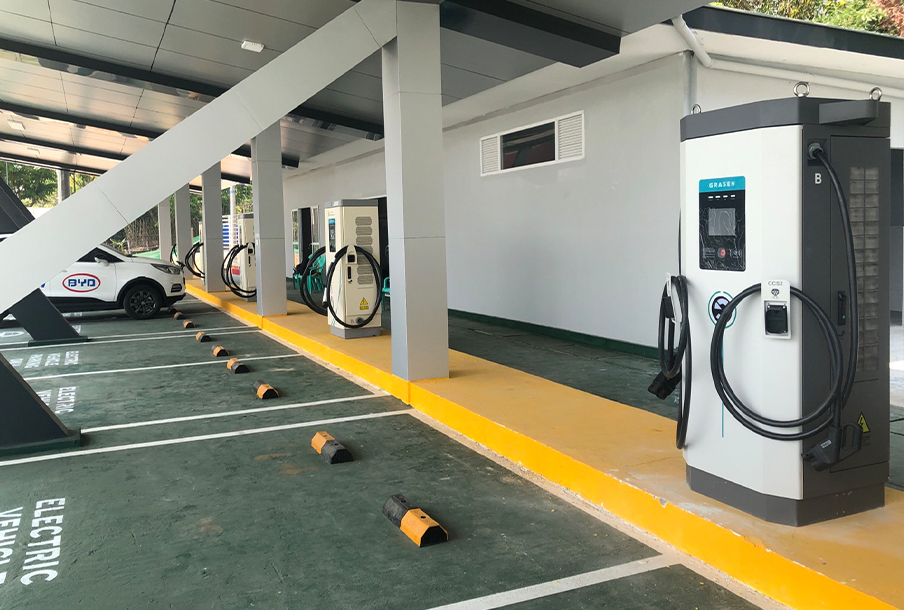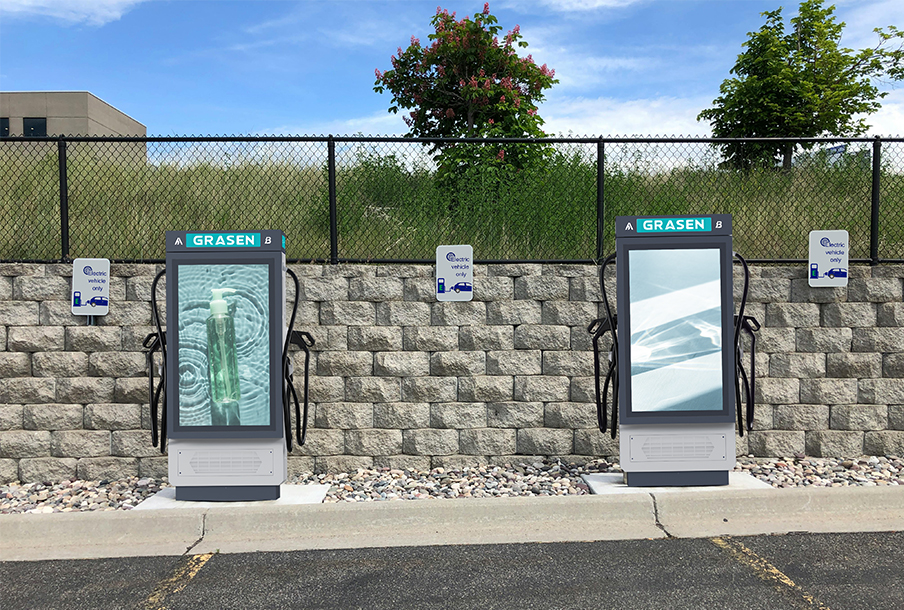



A 120 kW charger has two charging guns. If two cars plug in, do they both get 120 kW?
In most cases, you cannot tell from the number of connectors alone.
A dual-gun DC fast charger normally has a total output limit, and both charging sessions have to work within that limit. Exactly how the available power reaches each vehicle depends on the charger architecture and its power-allocation logic.
There is another variable as well: the cars themselves. One EV may ask for 90 kW while another only wants 40 kW, and those requests can change as their batteries fill.
So when comparing dual-connector chargers, the useful question is not simply “How many guns does it have?” It is “What happens to the power when both guns are in use?”
What Does a Dual-Gun DC Fast Charger Mean?
“Dual-gun” describes the physical charging arrangement: one DC charger cabinet is fitted with two charging connectors.
It does not, by itself, tell you the output available from each connector.
Suppose the charger is rated at 120 kW in total. With only one EV connected, that vehicle may be able to use most of the available output if its battery can accept it and the charger configuration allows it.
Plug in a second EV, and the situation changes. The two sessions now have to operate within the same 120 kW power envelope.
How that capacity is divided is determined by the charger’s power-sharing design.
How Does Power Sharing Work?
Take a simple 120 kW example.
One car is already charging and currently asks for 90 kW. At this point, the charger has enough capacity to meet that request.
A second car arrives and asks for 60 kW.
Now the combined request is 150 kW, but the charger can provide only 120 kW in total.
Something therefore has to change.
The charger may split the available power between the two connectors, or it may use another allocation method supported by its control system. The important point is that the total output still stays within the charger’s rated capacity.
This becomes especially relevant at sites where two EVs often charge at the same time. Two products may both be described as “120 kW dual-gun chargers” but behave differently once the second connector becomes active.
That difference comes down to the allocation strategy.
Equal Power Sharing vs Dynamic Power Sharing
There is more than one way to share the output between two charging sessions.
Equal Power Sharing
With equal allocation, both active connectors receive a defined share of the available output.
For a simplified 120 kW charger, that could look like:
120 kW available
Vehicle A: 60 kW
Vehicle B: 60 kW
The benefit is predictability. An operator knows how the charger will behave once both connectors are active.
According to Grasen’s official technical documentation, the referenced 40–160 kW integrated DC charger supports single-connector fast charging and can also operate two connectors at the same time with equal power allocation.
For this particular platform, equal sharing is the simultaneous-charging mode confirmed in the current documentation.
Dynamic Power Sharing
A system with dynamic allocation can respond differently as vehicle demand changes.
Imagine that 120 kW is available. One EV asks for 70 kW and the other for 50 kW. Both requests fit within the charger’s total capacity.
Later, the first vehicle reaches a higher state of charge and reduces its request to 30 kW. A system designed for dynamic allocation may then make more of the remaining capacity available to the second vehicle, provided that vehicle is able to use it.
The distribution can therefore move with the charging sessions rather than staying at one fixed split.
That can be useful at busy sites, but “dual-gun” does not automatically mean “dynamic power sharing.” These are separate specifications, and the actual allocation method should be checked for the model being purchased.
Why Does Vehicle Demand Matter?
Power sharing is not controlled by the charger in isolation.
The EV tells the charger how much power it can accept, and that value can change throughout the session.
Several things affect it:
· maximum DC charging capability;
· battery voltage;
· state of charge;
· battery temperature;
· charging curve.
Say one connector currently has 60 kW available, but the vehicle connected to it is asking for only 35 kW. The charger cannot simply push the remaining 25 kW into the battery.
Later in the session, the same car may reduce its demand even further as the battery approaches a higher state of charge.
This is why the power shown on the screen does not always match the maximum rating printed on the charger.
It also explains why two cars connected to the same unit can show different charging rates even when the hardware behind both connectors is identical.
For a site operator, vehicle behavior is part of the power-planning equation, not an external detail.
When Does a Dual-Gun Charger Make Sense?
A second connector becomes useful when charging sessions regularly overlap.
Consider a fleet depot where several vehicles return near the end of a shift. Two charging positions connected to one cabinet may give the operator more flexibility than a single charging point.
Taxi and ride-hailing sites have a similar issue. Cars arrive throughout the day, so there may frequently be more than one vehicle waiting for power.
The same idea can work in public charging areas or commercial car parks where two adjacent bays are expected to share one charger.
In these cases, the main advantage is access. One cabinet can serve two positions without requiring a second complete charger cabinet.
That does not mean every site needs two connectors.
A location where one vehicle charges at a time may gain little from the second gun. At the other extreme, a project that requires both bays to receive independent high power at all times may need additional installed capacity rather than simply another connector.
So the site’s charging pattern matters more than the connector count.
Before choosing the equipment, look at how many vehicles are likely to arrive together, how long they stay, and what level of charging power they actually need.
What Should Buyers Ask Before Ordering?
The words “120 kW dual-gun DC charger” leave several important details unanswered.
Start with the rated power. Ask whether the stated kW figure refers to the complete charger or to the output available from one connector.
Then ask the supplier to describe what happens after the second vehicle plugs in. Does the unit split power evenly? Does it follow another fixed rule? Can the allocation change with vehicle demand?
Single-vehicle operation is worth checking too. If only one gun is in use, how much of the charger’s total capacity can that session access?
Another useful question is what happens when one EV begins to taper its charging power. On some architectures, unused capacity may remain tied to the original allocation; on others, it may be available elsewhere.
Maximum output current per connector also deserves attention. A kW figure alone does not describe the full charging capability of the interface.
Finally, give the manufacturer some information about the vehicles and the way the station will operate. A charger selected for a taxi site may need to handle a very different usage pattern from one installed at a private fleet depot.
A useful supplier discussion therefore starts with actual operating conditions, not just a model number.
How Does Grasen Support Dual-Connector Projects?
For Grasen’s referenced integrated DC charger platform, the official product documentation confirms single-connector fast charging as well as simultaneous operation of two connectors with equal power allocation.
For a real project, that specification is only part of the selection process.
The charger also needs to make sense for the vehicles that will use it, the required power level, connector standard, number of charging bays and expected overlap between charging sessions.
These details can be reviewed with Grasen before the configuration is finalized.
That matters because a dual-connector unit installed at a fleet depot may be used very differently from the same type of equipment installed at a public fast-charging site. The hardware choice should reflect that operating pattern rather than relying on the “dual-gun” label alone.
Is a Dual-Gun DC Fast Charger Right for Your Site?
A dual-gun DC fast charger can be a practical choice when two vehicles regularly need access to the same charging unit and sharing the available output fits the way the site operates.
Before making the decision, check the charger’s total rated power, how that power is divided, the current limit of each connector and the charging needs of the vehicles.
If both bays need their own guaranteed high-power supply at the same time, a different system layout or additional installed power may make more sense.
Where the aim is to give two vehicles access to one charger while making effective use of the available capacity, a dual-connector design may be the simpler option.
Get a Dual-Gun Charger Configuration
Planning a dual-connector charging site?
To get the discussion started, send Grasen the information you already have: target country, charger power, vehicle type, connector standard, number of charging bays and whether two vehicles are expected to charge at the same time.
From there, the team can review the operating requirements and help determine whether a single- or dual-connector setup is a better fit for the project.
Email: [email protected]
Website: www.grasen.com
WhatsApp: +86 199 3989 0561
Tell us how the vehicles will use the site, and we can work from the actual charging demand rather than choosing a configuration from the specification sheet alone.