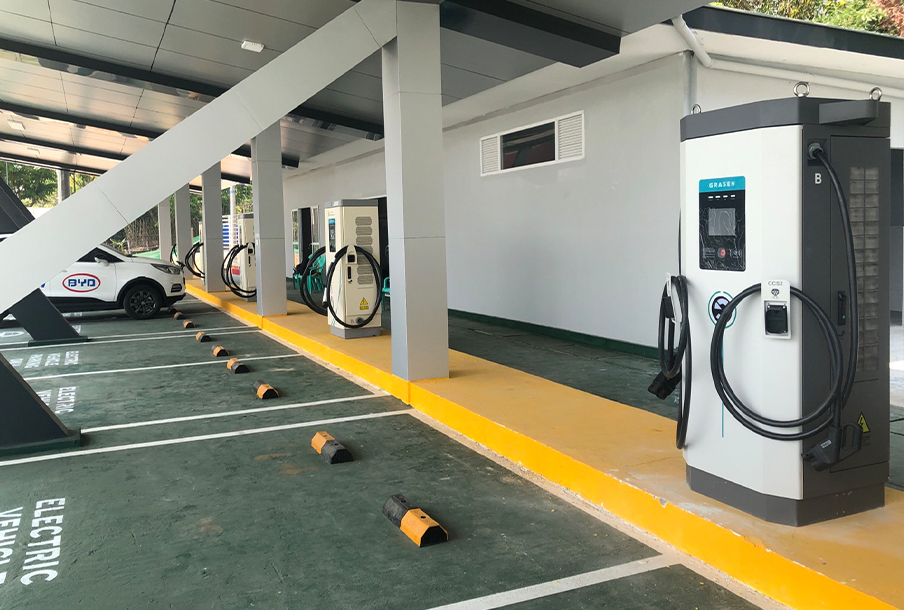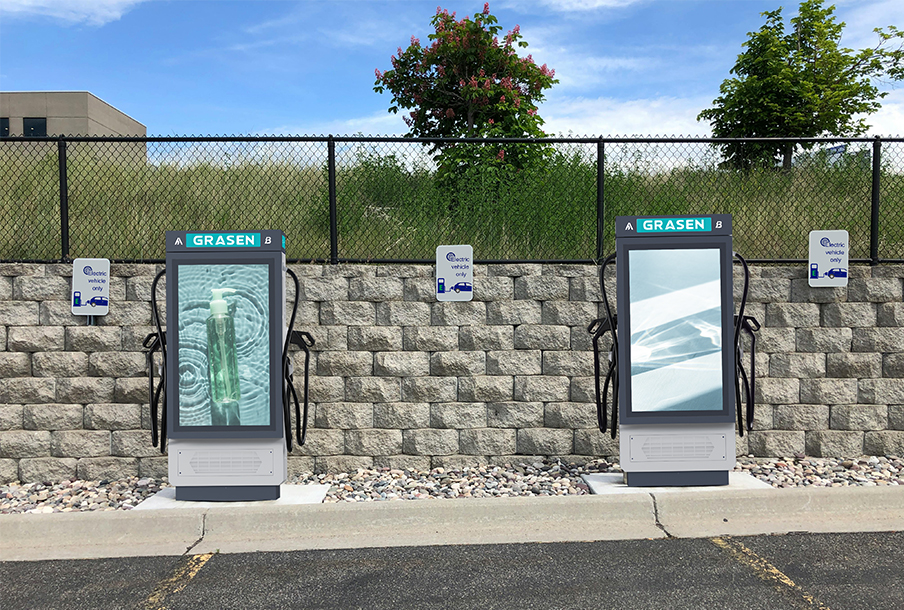



The site has four 120kW DC Fast Chargers for a total of 480kW of charging capabilities. The site is limited by its ability to provide electric power to EV charging; it is capable of providing up to 300kW of electric power to EV charging.
In most cases, operation is normal. However, there will be problems if you need to use all 4 chargers at once.
The installation of additional charging stations does not necessarily result in an increase in the amount of available electrical power. As the site becomes more active, the difference between the number of installed charging stations and the amount of electrical power that is actually provided can create problems for the charging operators.
An option to address this concern is EV charging load management. When power demands from EV charging devices are managed as a group, the amount of electricity being consumed may be optimized within the confines of the site's predefined limits.
This is the first issue, which involves the sharing of power among several vehicles that need to use the same power source at the same time.
Why More Chargers Do Not Always Mean More Available Power
The rated output of a charger is the maximum amount of power that the charger can provide when operating at peak performance. It does not indicate the total amount of power that could be provided to a complete charging site through the existing electrical service.
Think about a store like a mall. There are many things that use electricity such as lights, air-conditioning units, escalators and other building systems. When you install DC Fast Charging stations in this area you place an additional large load onto the existing electrical infrastructure.
Even with the theoretical capability of the installed chargers being able to provide up to 480kW of power, it is possible that the actual charging capacity available at the site will be much less.
Increasing the electrical capacity of the site may require upgrading the existing transformer or carrying out other electrical work. The cost will depend on the existing infrastructure and utility requirements. Utility approval may also take time, so this needs to be considered during project planning.
Before deciding on this type of upgrade, it is important for the operator to understand how much power the chargers are actually likely to use during the day.
Four chargers do not always deliver maximum output at the same time. The timing of when vehicles arrive, the condition of their batteries, and the required charging power for each vehicle vary greatly.
This is where EV charger load management becomes useful.
How EV Charging Load Management Addresses the Problem
At the most basic level, an EV charger load management system ensures that the combined power demand of all chargers remains below a specific maximum power limit.
In some cases, a charging site may have 300kW of total power available for multiple DC Fast Chargers. Rather than allowing each of the chargers to function at maximum capacity on its own, a coordinating control system can manage how much power is drawn from the grid.
There are two common approaches.
The system has an established upper limit with static load management. Once a maximum of 300kW has been designated for use by EV charging, that maximum will remain constant until the user alters the configuration.
Dynamic load management for EV charging can respond to changing conditions.
For example, if there is an increase in the electrical load on a commercial facility, then the amount of power that is available for vehicle charging will likely decrease. If other electrical loads are reduced, then there may be more power available for vehicle charging.
This is accomplished through proper monitoring, control and communication among the charging equipment and the site's management system.
Dynamic load management does not increase the electrical capacity available at the charging site. It helps decide what portion of the total available power can be used.
What Happens When Several Vehicles Plug In?
Consider again the four 120kW chargers.
The total amount of power available at the charging site is 300kW. The first two cars to arrive will be able to draw up to 120kW each.
The combined output is 240kW, leaving 60kW of the allocation unused.
Subsequently, two more vehicles arrive.
With 4 chargers each attempting to provide 120kW, the total power required would be 480kW. The total amount of power that could be provided is 180kW more than what the site can support.
An EV charger load management system could limit the combined output to 300kW.
One simple approach would assign 75kW to each charger.
However, an equal distribution is not always the optimal solution.
If a vehicle has only enough capacity to receive 35kW of charging power due to its battery being near full charge, depending on how much additional capacity exists and how the system controls allocation, the extra power may be directed towards other charging sessions.
The goal of this process isn't to make sure that each vehicle will have a quicker charge than before. Rather, the process seeks to optimize the utilization of power.
Charging performance is affected by the vehicle's needs, how hot or cold the battery is, the battery's state of charge, and the limitations of the vehicle and charging equipment.
This is an illustrative example only and does not reflect actual performance measurements from a Grasen site.
Load Management Is Not the Same as Power Sharing
These two concepts are very similar, however there is an important difference between them when designing a charging project.
Dynamic power distribution generally involves dividing up the available power among multiple charging outputs on a single charger or through a shared power system.
Grasen's R240 DC Fast Charger can deliver up to 240kW and supports dynamic allocation of available power between its two charging connectors. If two vehicles are charging at the same time, the available output can be distributed between the two charging sessions.
This is useful at the equipment level, however this is not to be confused with controlling the total electrical use of all charging units at a site.
Site-level load management is the coordination of power consumption among a number of chargers or charging units to ensure that all of them use no more than the amount of power that can be supplied by the site.
Grasen's split-type DC charging systems, the S960 and S1600, have been designed with a feature that allows for dynamic load management across different charging units. The use of this type of feature is especially useful at charging stations where there are multiple vehicles that will need to charge with high power at the same time. 15-EV Charging Load Management …
The distinction here is very important, because one function controls how power within the charging equipment is distributed, and the other controls the combined power demand of all charging units in relation to the power available at the site.
For larger projects, both capabilities may be applicable based on the equipment architecture and site requirements.
Where EV Charging Load Management Makes the Greatest Impact
Public DC Fast Charging Stations
Public charging demand is rarely consistent.
Charging stations could be idle for many hours and then be utilized heavily by multiple vehicles over a short amount of time. Designing every charging facility with the idea that every charger would continuously use its maximum output can result in much higher infrastructure costs.
Site-level EV charger load management provides operators with an alternative option.
Coordinating power demand across multiple compatible charging units allows more flexibility when meeting fluctuating demand while staying within the site's electrical capacity.
Dynamic load management for EV charging can help control peak electricity demand. However, the exact amount of money saved depends upon the rates charged by the electric company, how the facility is used, and the way the system is programmed.
In installations of high-power systems that utilize split-type charging systems, as the quantity of charging units increases, so does the significance of these considerations.
Fleet Charging Depots
Fleet charging presents a different challenge.
Delivery vehicles such as delivery trucks, service vans, and electric buses may arrive back at their depot at about the same time. However, it does not mean that all of these types of vehicles will need the same level of energy nor will they all depart from the depot at the same time.
Vehicles which depart from the station at 6:00 AM may have to complete their charging process prior to those which remain at the station through 12:00 PM.
If the charging management system is capable of performing the required scheduling and prioritizing tasks, then available power may be distributed to meet the operational requirements.
In particular, this is very important for fleets that are expanding their charging network and not yet able to increase the amount of electricity they can draw from the grid.
The main focus for operators isn't necessarily getting as fast of a charge as possible. Rather, it's about making sure the vehicles have enough energy before their next scheduled departure.
Before Adding More Chargers, Assess These Three Factors
The first item that needs to be reviewed is the electrical capacity of the location where you will install your charging station.
How much power is available for EV charging after considering all of the other electrical loads on the site, the required electrical protection, and any operating conditions? A correct electrical survey will provide this data.
Next, consider how the site will actually be utilized.
A highway charging hub, a retail center, and a bus terminal may have different charging schedules for their DC fast chargers. The design should take into account when vehicles arrive, how long they stay parked, and how many are being charged simultaneously.
Finally, confirm the equipment's control capabilities.
When choosing an EV charger with load management, do you require power sharing among the outputs of each individual charger, or do you need dynamic load management across several charging units? Will the proposed chargers be compatible with the selected management system? How will charging limits be coordinated when demand fluctuates? These are important questions to consider prior to ordering equipment.
For those projects that require several high-power charging stations, Grasen offers two different models, the S960 and S1600, which support site-wide dynamic load management. EV charging load management should match the specific electrical design of the location as well as the operational requirements of the site.
A charging station works most efficiently when the hardware, available electrical supply and actual vehicle usage are considered together.
Adding another charging station may look simple on paper. Making sure the whole site can use that additional charging capacity effectively takes more planning.