


How long does it take to charge an electric car? A single figure can’t paint the full picture with multiple factors involved. Here is an overview to help you estimate the charging time for your electric car.
Power Output
Power Output is the most important aspect of all. Usually ranging from 3.7 kW to over 420 kW, EV Chargers can be divided into 2 types - AC charging and DC charging. While an AC charger can take up to 9 hours to reach an 80% charge, a DC fast charger can achieve the same in less than 1 hour.
AC charging ( Level2 Charging)
Level 2 charging refers to the most common type for daily EV charging, using AC power supply through a charging station. It typically adds 20–40 miles of range per hour and is widely used at homes, workplaces, and public locations for overnight or daytime charging.
DC charging ( Level3 Charging)
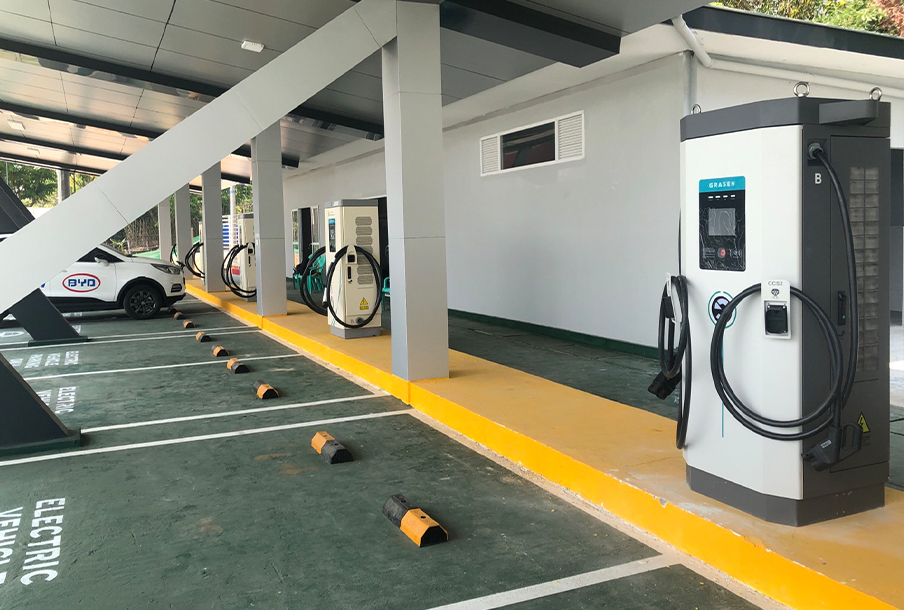
Level 3 charging can deliver higher output power faster charging speeds, making them ideal for EV drivers who are always on-the-go. It serves as the commercial charging solution at places such as highway service area, urban parking lots, and commercial fleet hubs.
Vehicle Charging Capability
In terms of charging capability ,pure electric vehicles (BEVs) generally have a clear advantage over most plug-in hybrid and range-extended electric models (PHEVs/EREVs).This is because BEVs are designed to support high-power fast charging, with mainstream models usually supporting DC fast charging at 150–350 kW or more. Some premium models even offer capabilities such as "400 km of range added in just 10 minutes of charging." But most plug-in hybrids and range-extending electric vehicles, just support AC slow charging at 3~7 kW. Only a few models even have DC fast charging--then usually less than 20-50 kW, which is significantly lower than that for pure electric vehicles.
State of Charge(SoC)
Consider the State of Charge (SOC) as the fuel gauge in a gas car: an SOC of 80% means your battery lefts 80% capacity. When it drops to 20%, that means the battery almost drains -- it’s time to charge. You might also notice that when using public fast chargers: it only takes a few minutes to go from 0 to 80% , but getting further up to 100% is quite time consuming. It is your EV's BMS that is at work here. It keeps the charging power in line with the SOC of the battery so as to ensure it is never overcharged, thus protecting the battery. (As charging, the BMS continually monitors the voltage, temperature and ambient conditions of the battery. It dynamically adjusts charge current and voltage to ensure both safety and high efficiency during the entire process. For example, it allows for a slightly higher current at the front to replenish power quickly but then as the battery's voltage rises or temperature go up, gradually reduces charging power--shifts into a slow and gentle mode for longer charging periods to avoid overheat or over-voltage.)
Thus, the charging speed will fluctuate during different stages of the charging process. Generally speaking, the charging process can be divided into three stages.
Temperature
How Does Temperature Affect Charging?
Whether in extreme cold or heat, the battery's “operating state” is affected, leading to slower charging and reduced efficiency.
The batteries currently used in electric cars are highly temperature-sensitive.
In cold weather:The mobility of charged particles is reduced, leading to reduced charging and discharging capability. Tests show that at -7°C, the range shrinks significantly compared to temperatures of 23°C or 35°C .
In hot weather: chemical reactions inside the battery will accelerates, so it can charge a bit more quickly.
The good news is that modern electric car designs account for this.They're usually equipped with smart temperature monitoring system that can automatically reduce charging power or stop charging when needed. This not only helps extend battery life but is also key to keeping the charging process safe.
Learn more about EV charging
We hope this article helps you get better understanding about EV charging. If you have further questions or want to find the suitable EV charging solution, speak with our experts for a personalized guidance now.