


What is the difference between OCPP 1.6J and OCPP 2.0.1?
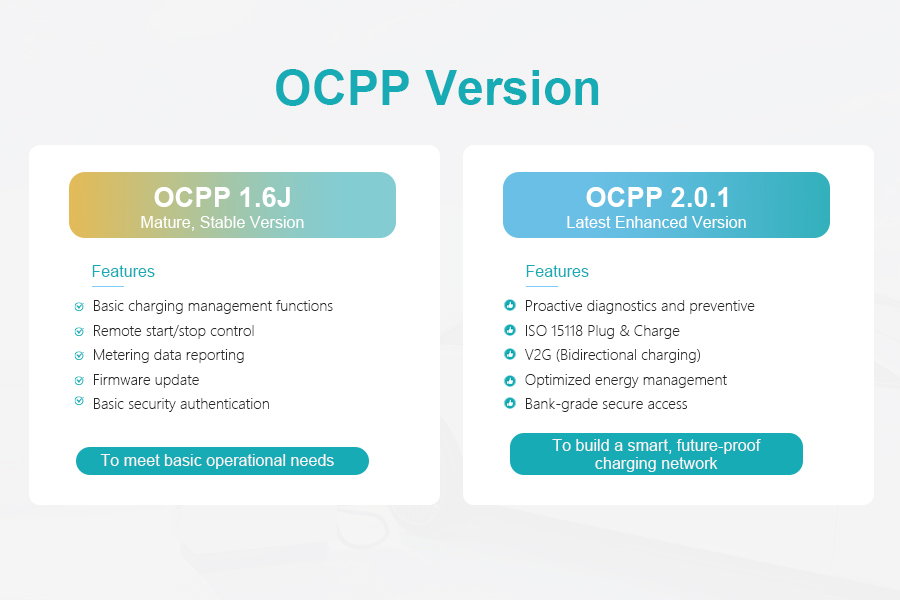
The Open Charge Point Protocol (OCPP) serves as the international standard for communication between EV charging stations and central management systems. As the electric vehicle industry evolves, so does OCPP. The shift from the widely used OCPP 1.6J to the newer OCPP 2.0.1 represents a revolution—not just in feature upgrade. While OCPP 1.6J offers the basic service of charging, OCPP 2.0.1 unlocks a new era of intelligent, safe, and future-proof charging ecosystem.
Why Is OCPP 2.0.1 Not Mainstream Yet?
While OCPP 2.0.1 is the more advanced and secure version with some improved smart charging and communication features, We all notice that most EV chargers and management systems currently are still running on the older OCPP 1.6J. It hasn’t yet become the mainstream for a few practical reasons.
The key reason boils down to this: it's not that the new technology isn't better—it's that the old OCPP1.6J still works perfectly well, and upgrading is a significant cost and operational hassle.
After years of development, the ecosystem based on OCPP 1.6—particularly the mature OCPP1.6J version—has become highly refined in terms of hardware, software, and operational support. It already meet the basic needs of current EV charging and support core functions such as remote start-stop, remote monitoring, OTA, and billing.
OCPP 2.0.1, however, is built for the future. Its key features—like Plug & Charge, vehicle-to-grid (V2G) support, and better security—still rely on the growth of the whole ecosystem. These features include wide use of the ISO 15118 standard in electric vehicles, supportive regulations, and refined backend software. Since this ecosystem isn't fully mature yet, many operators are taking a wait-and-see attitude towards upgrading to OCPP 2.0.1. Some concern that it might be a costly upgrade with uncertain returns.The good news is, despite the lack of strong driving forces, the shift is happening as the EV industry developing toward more intelligent and grid-responsive charging.
Moreover, this shift isn’t just a simple software upgrading. The older EV chargers might not work well with OCPP2.0.1, which could call for a complete hardware replacement. Running a mix of 1.6 and 2.0.1 EV chargers makes operations and maintenance particularly troublesome.
That being said, the shift to OCPP2.0.1 is the prevailing trend. Regulations in regions like Europe are already mandating smart charging capabilities aligned with OCPP 2.0. As EV adoption grows, the advanced energy management tools of OCPP 2.0.1 will become essential. Right now, the industry is in a transition period, moving steadily from the reliable "good enough" of 1.6 to the intelligent, grid-ready future of 2.0.1.
EV charging is far more complex than simply "plugging in" — it involves a sophisticated interplay of regulations, standards, and protocols. Standardization and interconnectivity remain essential prerequisites for the industry to reach maturity.