


A new charger does not always start with a product roadmap. Sometimes, it starts with a customer asking for something different.
At the Canton Fair, an overseas customer asked Grasen whether we could build a four-gun DC fast charger for his charging project. After reviewing the request, our team produced a customized sample. The customer was satisfied with the result and later ordered 50 customized four-gun chargers.
That project made us look more closely at what the customer actually needed. It was not simply about adding two more charging guns. The goal was to serve more charging bays from one cabinet, support different vehicle requirements and keep the site practical to operate.
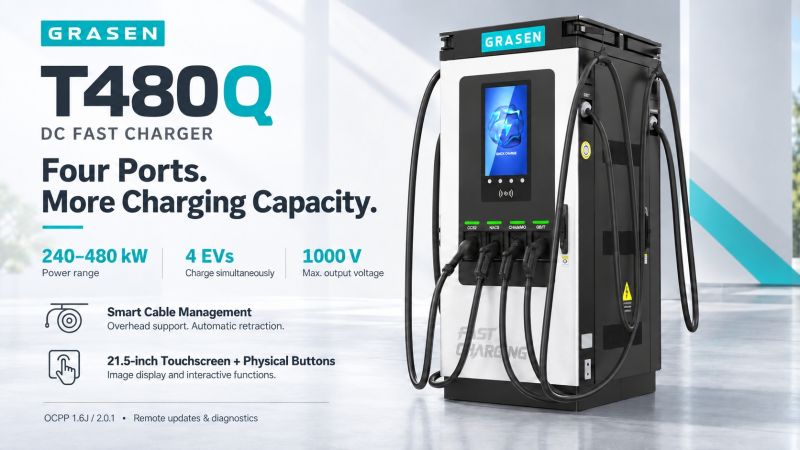
That experience became part of the thinking behind the new Grasen T480Q, a high-power 480kW DC fast charger platform available from 240kW to 480kW with four DC charging guns.
Why Four Charging Guns Matter at Busy Charging Sites
At a high-traffic charging station, maximum power is only part of the story.
A charger may have plenty of available output, but vehicles can still queue when charging access is limited. This is especially noticeable at public charging hubs, highway service areas and fleet sites where several vehicles may arrive within a short period.
The T480Q integrates four DC charging guns into one cabinet, giving operators more options when planning several charging bays around one charger.
For buyers looking at a 4-gun DC fast charger, the real value is not simply the connector count. It is the ability to organize more charging access around one piece of equipment.
Instead of placing a separate charger cabinet beside every charging space, a multi-gun layout can make the site more centralized and easier to plan.
The same configuration may sometimes be described as a four-connector DC fast charger or a four-port DC fast charger, but “four-gun” and “4 guns” are more commonly used in current EV charger product terminology.
240–480kW Power for a Multi-Gun Charging Setup
A multi-gun charger also needs enough power behind the connectors.
The T480Q can be configured from 240kW to 480kW, so the project is not locked into one power rating.
For a busy charging hub, a 480kW EV charger configuration may provide the power capacity needed for higher traffic. At another site, 240kW or another configuration within the range may make more sense based on grid capacity and expected charging demand.
This flexibility matters because a high-power charger should be matched to the site rather than selected only by the largest number on the specification sheet.
Connector requirements also vary from one market to another.
The T480Q supports configurations for CCS1, CCS2, CHAdeMO and GB/T. CCS1, CCS2 and GB/T configurations support rated DC voltage up to 1000V, while CHAdeMO is rated up to 500V DC.
For distributors and project developers, this makes the T480Q easier to configure for different regions and vehicle fleets.
A project in Europe may require a different charging interface from a project in North America or Asia. The charger therefore needs to fit the market, not the other way around.
Four Charging Cables Without the Usual Cable Mess
Four charging guns also mean four heavy DC cables.
If cable handling is ignored, those cables can spend the day lying on the ground, crossing into nearby charging bays or becoming harder for drivers to handle after repeated use.
The T480Q uses an overhead cable management system to make connector handling easier and help the cable return to position after charging.
For drivers, that means less effort when pulling and returning the charging connector.
For operators, it helps reduce unnecessary cable dragging and keeps the charging area more organized.
This becomes more important at commercial sites where the charging guns may be handled repeatedly throughout the day.
A 4 guns DC EV charger should not simply put four cables on the same cabinet. The cable system has to make those four charging points practical in daily use.
A 21.5-Inch Screen, Plus Physical Controls
Charging equipment also has to work outside the ideal conditions of a showroom.
The T480Q combines a 21.5-inch LCD touchscreen with physical function buttons. Drivers can use the large display for charging information and on-screen guidance, while the buttons provide another way to operate the charger when touch input is less convenient.
That may be useful in rain, cold weather or when a driver is wearing gloves.
Status indicators above the connector holders also make it easier to check the condition of each charging gun without relying only on the main screen.
These are relatively simple details, but at a busy charging site they affect how quickly drivers understand and use the equipment.
Built for Connected Commercial Charging
For a single charger, many maintenance tasks can still be handled on site.
Once a network grows to dozens of chargers, that approach becomes much less practical.
The T480Q supports OCPP 1.6J and OCPP 2.0.1, together with 4G, Ethernet and Wi-Fi connectivity. Its remote-operation functions also include FOTA updates, remote log access and remote fault diagnosis.
For CPOs, distributors and project developers, these functions help the charger fit into a larger operating network.
Software updates or initial fault checks do not always need to begin with an engineer travelling to the charging station.
This is an important difference between simply buying a high-power DC fast charger and deploying charging equipment that has to remain manageable after installation.
Designed for Everyday Commercial Operation
A commercial DC fast charger may operate outdoors for long hours and face very different conditions throughout the year.
The T480Q has an IP55 enclosure rating and an operating temperature range from -30°C to +50°C. Forced-air cooling supports thermal management, while high-temperature-resistant cables are used in the electrical design.
These specifications matter because commercial charging equipment may face heat, low temperatures, rain, dust and repeated daily use.
For an operator, long-term performance depends on more than the headline 480kW figure.
Cooling, cables, electronics, communication hardware and mechanical design all have to continue working after the charger has been installed and put into daily service.
Where Does a 480kW 4-Gun DC Fast Charger Fit Best?
The T480Q is designed for commercial sites where traffic volume, charging access and equipment utilization are important.
At public fast-charging stations, four charging guns can give site planners more flexibility when arranging several charging bays.
At highway charging hubs, high vehicle turnover makes both available power and charging access important.
Fleet charging sites may see several vehicles return within similar operating windows, creating concentrated charging demand.
The same applies to taxi and ride-hailing charging stations, where charging equipment may be used repeatedly throughout the day.
Commercial parking facilities can also benefit from a more centralized multi-gun DC fast charger layout when several charging spaces need to be planned around one cabinet.
A 480kW configuration is not automatically necessary for every site. The final T480Q setup should still be based on available grid capacity, vehicle requirements, connector standards, traffic patterns and backend needs.
Configure the T480Q for Your Charging Project
The new T480Q combines a 240–480kW power range, four charging guns, multiple connector configurations and remote operation functions in one high-power DC charging platform.
If you are planning a public charging station, highway charging hub, fleet site or another high-traffic commercial charging project, send us your target market, required power, vehicle types, connector combination, number of charging bays and backend requirements.
Our team can review a suitable T480Q configuration for the project.
Email: [email protected]
Website: www.grasen.com
WhatsApp: +86 199 3989 0561